Uninterruptible Power Systems for Healthcare Facilities
Rapid-deployment temporary emergency power plus EPSS testing and documentation support, delivered end-to-end from equipment sourcing and logistics to commissioning and on-call operations.
Power Continuity for Critical Care Environments
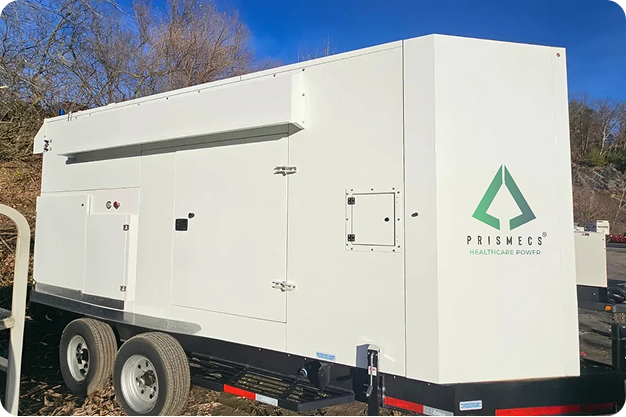
Prismecs Healthcare Power stabilizes patient-critical loads during utility instability and outages by deploying temporary power generation solutions with UPS and transfer coordination, backed by commissioning discipline.
Rapid Deployment
Mobilize temporary emergency power with coordinated sourcing, staging, delivery, and site-ready setup.
UPS Coverage
Uninterruptible power supply for healthcare to bridge transfer events and stabilize sensitive equipment.
Generator Backup
Hospital backup generator packages engineered for runtime and emergency power continuity.
Prismecs Healthcare is built for healthcare emergency power delivery where speed, safety, compliance, and operational control matter.
Healthcare-Specific Delivery
Built around clinical loads, facility constraints, and readiness expectations
Single Accountable Partner
One team for sourcing, logistics, installation, commissioning, and support
OEM-Agnostic Sourcing
Equipment selected to match runtime needs, site conditions, and compliance requirements
02 Hours
Minimum of 2 hours @ 100% load
96 Hours
Minimum of 96-hour fuel strategy
10 Seconds
Critical Branch Transfer in ≤10 seconds
Resiliency, Emissions, and Cost
Prismecs Healthcare deployments are designed to strengthen resiliency, support lower-emission configurations, scale with power requirements, and deliver predictable cost structures.
Resiliency First
N+1 capacity and failover-ready architecture sized around critical loads, transfer performance, and runtime targets.
Sustainability Path
Supports lower-emission configurations and operating strategies, including optimized loading and reduced run-hours where feasible.
Low NOx Options
Low-NOx generator configurations available where permitting, air-quality limits, or site emissions requirements apply.
Lower Carbon Emissions
Natural gas and hybrid-ready configurations can lower CO₂ intensity relative to legacy diesel-only operating profiles, as applicable.
Scalable Coverage
Modular units enable stepwise capacity expansion and redundancy scaling as power requirements change.
Cost Clarity
OPEX rental with customizable billing cycles, transparent pass-throughs, and reduced coordination overhead improves cost predictability.
Commercial Model
Emergency Power You Can Trust
Critical-load continuity through transfer events, runtime targets, and verified deployment.
Scalable capacity with low NOx and lower-carbon configuration options as applicable.
Customizable rental cycles and fewer handoffs for clearer cost control.
Response and Preparedness
Choose emergency response power, a preparedness contract, or a replacement bridge based on your outage risk, renovation schedule, or generator replacement timeline.
1
Assess & Size
Confirm critical loads, transfer approach, runtime needs, and fuel assumptions based on outage scenarios and site constraints.
2
Source & Stage
Allocate the right generator package and accessories with logistics planning, including resupply coordination as needed.
3
Install & Integrate
Healthcare-aware setup with ATS/switchgear interfaces as required.
4
Commission & Verify
Functional checks and documentation aligned to facility expectations, including verification of alarms and event logging where used.
5
Support Operations
On-call support through the rental term, with optional monitoring and readiness reporting.
Reliable Backup Power New Haven Healthcare Facilities
When healthcare facilities face utility instability, power continuity is non-negotiable. In New Haven, Prismecs Healthcare Power delivered a 390 kW natural gas backup power solution. The deployment ensured uninterrupted support for essential and patient-critical loads.
The modern EV supply chain extends far beyond vehicle assembly. It spans power generation assets, energy storage systems, grid-connected charging infr...
Uninterruptible power systems for healthcare facilities
Frequently Asked Questions
These are the questions we hear more often.
Sizing should account for branch loads plus motor-starting kVA/inrush and acceptable voltage/frequency dip during start and transfer events. Prismecs MedicalPower performs load analysis and configuration planning, so your temporary generator setup supports starts, transfers, and steady-state runtime without unstable performance.
Sizing should account for branch loads plus motor-starting kVA/inrush and acceptable voltage/frequency dip during start and transfer events. Prismecs MedicalPower performs load analysis and configuration planning, so your temporary generator setup supports starts, transfers, and steady-state runtime without unstable performance.
ATS transfer is typically verified monthly by exercising transfer to emergency power and return to normal power with documented results. Prismecs MedicalPower coordinates ATS checks with generator readiness, so the full EPSS transfer path is verified end-to-end.
For Type 1 essential electrical systems, life safety and critical branches are expected to restore power within 10 seconds using automatic transfer switching. Prismecs MedicalPower plans commissioning and acceptance checks around transfer timing and documented outcomes.
Monthly EPSS testing commonly includes a simulated outage with both automatic and manual transfer, performed under a structured program with documented results. Prismecs MedicalPower supports repeatable monthly test execution and documentation control to reduce gaps that can drive findings.
A 4-hour load test is an extended run verification performed at prescribed intervals to confirm the EPSS can carry load continuously, using facility load and/or a load bank with documented results. Prismecs MedicalPower plans the load strategy, logistics, and reporting, so the test is completed reliably with minimal disruption.
Type defines the allowed time to restore power (commonly Type 10), Class defines the required minimum runtime, and Level 1 applies where failure could result in serious injury or loss of life. Prismecs MedicalPower aligns equipment selection and verification steps to the applicable Type/Class/Level expectations tied to your clinical risk profile.
NFPA 110 requires Level 1 emergency power systems in healthcare facilities to have sufficient fuel capacity for continuous operation, with 96 hours being the commonly referenced target for critical facilities. However, this requirement can be met through a combination of on-site storage and documented fuel resupply contracts (MOUs) with reliable suppliers. The Joint Commission evaluates your emergency operations plan rather than mandating rigid on-site quantity. Prismecs MedicalPower performs fuel capacity assessments, designs storage configurations, and validates resupply logistics, so your facility meets both code requirements and accreditation expectations without excessive capital investment.
Wet stacking occurs when diesel generators operate below 30% load, causing unburned fuel and carbon buildup in the exhaust system. NFPA 110 mandates monthly 30-minute tests at a minimum of 30% load, but true prevention requires periodic operation at 75% load to achieve proper exhaust temperatures. Healthcare facilities often face wet stacking risks because actual emergency loads are inconsistent. Prismecs MedicalPower conducts load profiling analyses, implements automated load bank integration, and monitors exhaust temperatures continuously so your generators maintain proper combustion efficiency and avoid costly engine damage.
NFPA 110 requires weekly battery inspections and monthly performance testing for all emergency generator starting systems. For lead-acid batteries, monthly specific gravity testing is mandatory (or conductance testing as an approved alternative). Batteries must support three 75-second cranking cycles and recharge fully within 24 hours. The standard also mandates automatic battery chargers, low voltage alarms, and terminal connection checks. Prismecs MedicalPower implements digital battery monitoring systems that track voltage, temperature, and conductance automatically, ensuring compliance while reducing manual testing burden and preventing no-start failures during critical events.
Generator rooms require precise environmental control: temperature between 64-80°F (18-27°C) with a maximum of 20°F rise above ambient, relative humidity at 40-60%, and ventilation providing 30-60 air changes per hour depending on generator size. Exceeding 104°F reduces generator capacity by approximately 15% per 18°F increment. NFPA 110 and manufacturer specifications require combustion of air, heat removal, and exhaust fume management. Prismecs MedicalPower engineers ventilation systems with automated temperature monitoring, louver controls, and airflow verification so your generator rooms maintain optimal conditions that ensure reliable starting and prevent thermal derating during emergencies.
Load bank testing uses artificial resistive/reactive loads to validate generator performance independent of facility conditions, required annually and during commissioning. Building load testing uses actual facility loads, but risks operating below 30% load, causing wet stacking. NFPA 110 requires 30% minimum load during monthly tests; if building load cannot achieve this, load banks become mandatory. Prismecs MedicalPower performs load capability assessments, deploys portable load banks when facility loads are insufficient, and implements permanent load bank integration so your monthly tests achieve required percentages without disrupting operations or causing engine damage.
Exhaust systems must limit noise to 70 dBA at property lines, maintain exhaust gas temperature above 250°F to prevent condensation, and route through fire-rated enclosures per NFPA 110. Hospital exhaust requires hospital-grade silencers, stainless steel piping with flexible sections rated to 1200°F, and seismic restraints in zones 3-4. Exhaust backpressure must remain within manufacturer specifications (typically under 20 inches water column). Prismecs MedicalPower engineers complete exhaust systems with thermal calculations, acoustic modeling, and seismic bracing so your installation meets environmental regulations, protects generator performance, and ensures safety during extended emergency operation.
Healthcare generators require separately derived systems with ground fault protection per NEC 517.17, including ground fault relaying on normal feeders and emergency feeders. The neutral must be bonded at the generator, not the transfer switch, with ground fault sensors on both sides of ATS. For essential electrical systems, ground fault protection must be selective and coordinate with downstream devices. Generator frames require two grounding electrodes per NFPA 70. Prismecs MedicalPower designs grounding systems that coordinate with facility ground grids, implements selective ground fault coordination studies, and verifies compliance during commissioning so your system meets stringent healthcare electrical safety requirements while preventing nuisance trips.
Talk to Power Experts
Get healthcare emergency power support for outages, preparedness planning, or generator replacement bridges with one accountable Prismecs team.